「データ信用保証機構(DCGO)による信頼のアンカーモデル」に関するプレプリントを公開しました。
2026-10-14
- article
「データ信用保証機構(DCGO)による信頼のアンカーモデル」に関するプレプリントをarxivに公開しました。
分野や地域を横断したデータ取引市場が拡大する一方で、組織内でのデータ利用を支えてきた暗黙の信頼は、分野を越えた取引にそのまま持ち込むことができません。認証や監査の結果はデータ市場やデータスペースごとに個別に蓄積され、別の市場では通用しないため、同じ提供者やデータに対して身元確認、権利確認、品質確認が取引のたびに繰り返され、参加のコストや取引成立までの時間が増大しています。
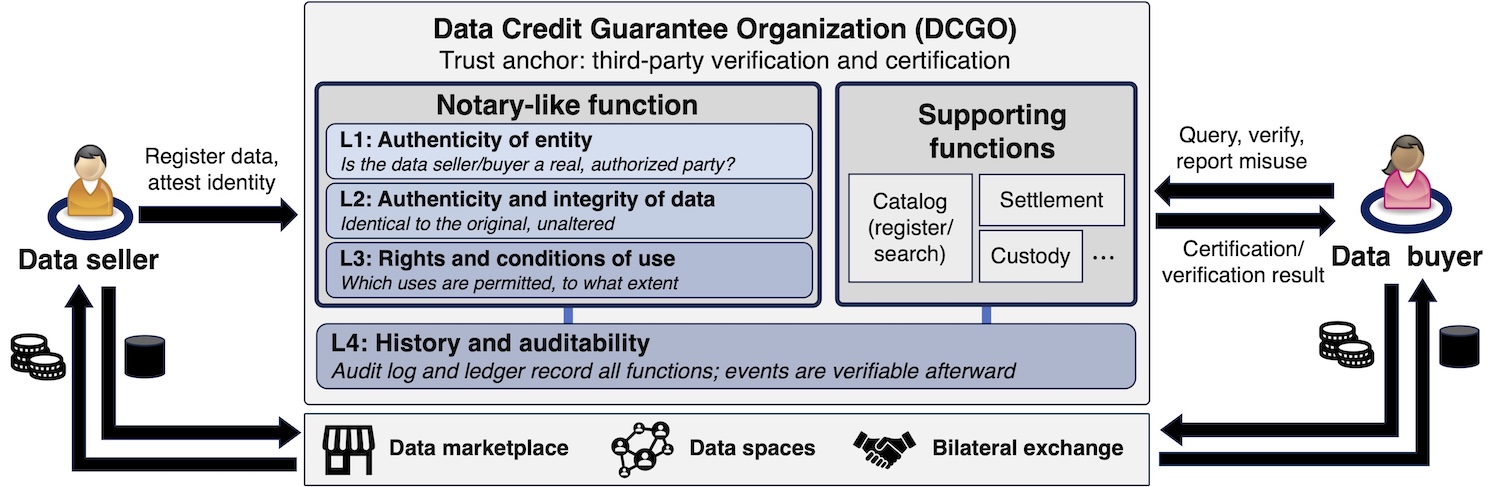
本研究では、第三者による検証・認証を通じてこの課題に取り組む「データ信用保証機構(DCGO: Data Credit Guarantee Organization)」を題材に、データを信頼するとはどういうことか、認証によって何がどこまで支えられるのか、そして、どのような条件下でDCGOが既存の取引モデルより優れているのかをエージェントベースシミュレーションによって検討しました。
まず、本研究ではデータに対する信頼を「実体の真正性(Authenticity of entity)」、「データの真正性・完全性(Authenticity and integrity of data)」、「権利・利用条件(Rights and conditions of use)」、「履歴・監査可能性(History and auditability)」という4つの層に分解し、第三者が認証できるのはデータの真正性までであり、内容そのものの正しさまでは保証できないことを示したうえで、DCGOを既存のマーケットプレイスやデータスペースを横断する信頼のアンカー(trust anchor)として位置づけました。さらに、中世の商人法(Law Merchant)モデルに、データに特有の「事後検知の不完全性」、「匿名アカウントの取り直しやすさ」、「被害の非競合性(コピーによる被害の拡散)」という3つの性質を組み込んで拡張し、マルチエージェントシミュレーションにより、第三者を介さない相対取引とDCGOとを比較しました。
分析の結果、DCGOを導入すると、市場環境によらず買い手の利得が理論上の上限に近い水準で安定して保たれる一方、相対取引では不正が必ず検知される状況であっても損失が生じ続けることが明らかになりました。また、身元確認は不正記録の共有を機能させるための前提条件であり、被害の拡散そのものを抑えられるのは取引前の事前検証のみであることも示されました。売り手側の分析では、価格プレミアムが手数料を上回る限り誠実な売り手は自発的にDCGOへ参加すること、ただし参加者のロックインや、普及に必要な一定数の確保には制度的な後押しが必要であることも確認されました。
本研究は、第三者による検証・認証の仕組みが分野横断的なデータ取引において果たしうる役割を明らかにするものであり、今後はデータの利用条件(権利・利用範囲)に関する層のモデル化や、複数市場間での信頼の相互運用性の検証も含め、持続可能なデータ市場・データエコシステムの制度設計に向けた研究を進めていきます。
https://arxiv.org/abs/2610.18400
タイトル:Institutionalizing Trust in Data Exchange: Trust-Anchor Model of the Data Credit Guarantee Organization and Its Simulation-Based Comparison
著者:Hiroshi Mano, Chie Sugiyama, Teruaki Hayashi
アブストラクト:Data trading markets that span industries and regions are expanding, but the implicit trust that supports data use within an organization does not carry over to cross-domain exchange. This paper examines the Data Credit Guarantee Organization (DCGO), a proposal to institutionalize trust through third-party verification and certification, and asks what it means to trust data, what such certification can support, and under what conditions DCGO outperforms existing trading models. We decompose trust in data into four layers: authenticity of entity, authenticity and integrity of data, rights and conditions of use, and history and auditability. A third party can certify authenticity but not the correctness of content, and DCGO is positioned as a trust anchor spanning existing marketplaces and data spaces. We then extend the Law Merchant model with three data-specific properties, namely imperfect ex-post detection, cheap pseudonyms, and non-rivalry of harm, and compare bilateral trading with DCGO by agent-based simulation. DCGO keeps the buyer's payoff near its theoretical upper bound regardless of the market environment, whereas bilateral trading loses even when fraud is always detected. Identity verification proves to be a prerequisite for record sharing, and pre-verification is the only function that limits the spread of harm. On the seller side, honest sellers join voluntarily whenever the price premium exceeds the fee. Lock-in and a critical mass for diffusion, however, call for fee governance and support for entry.