
Preprint Released: “Institutionalizing Trust in Data Exchange: A Trust-Anchor Model for the Data Credit Guarantee Organization”
2026-10-14
- article
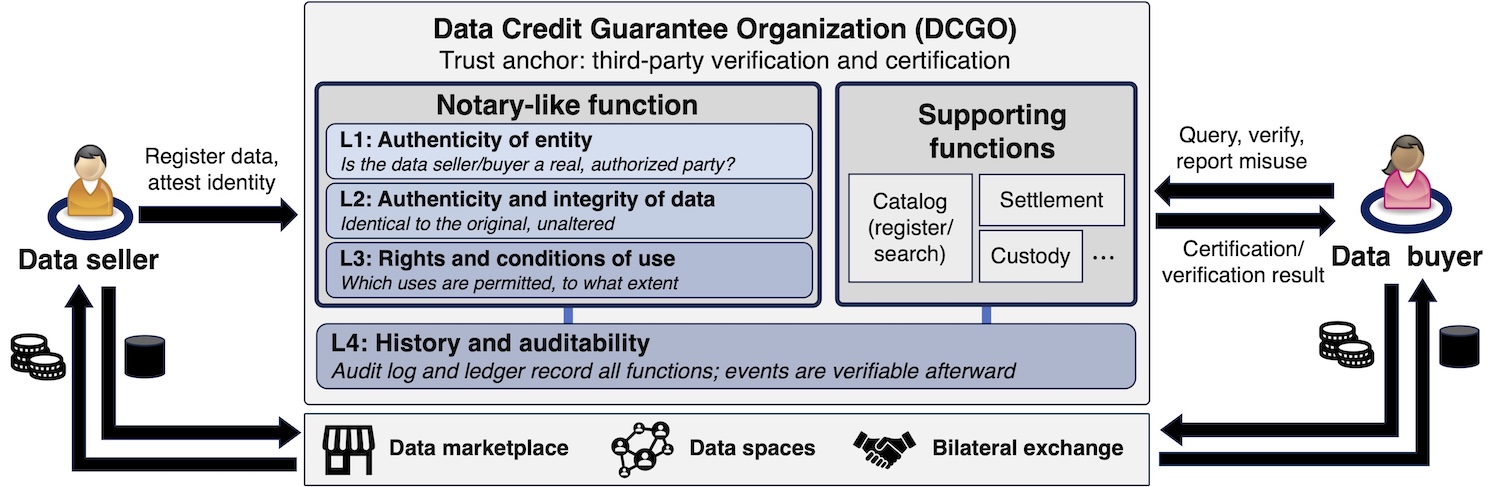
We have released a preprint on arXiv titled "Institutionalizing Trust in Data Exchange: Trust-Anchor Model of the Data Credit Guarantee Organization and Its Simulation-Based Comparison."
Data trading markets that span industries and regions are expanding, but the implicit trust that supports data use within an organization does not carry over to cross-domain exchange. Certification and audit results accumulate separately within each data marketplace or data space and are not recognized elsewhere, so identity verification, rights verification, and quality verification for the same provider or data must be repeated at every transaction, raising the cost of participation and the time needed to complete a trade.
This study takes up the Data Credit Guarantee Organization (DCGO), a proposal to address this challenge through third-party verification and certification, and uses agent-based simulation to examine what it means to trust data, what such certification can support, and under what conditions DCGO outperforms existing trading models.
First, we decompose trust in data into four layers (authenticity of entity, authenticity and integrity of data, rights and conditions of use, and history and auditability), and show that a third party can certify authenticity but not the correctness of content itself. On this basis, DCGO is positioned as a trust anchor spanning existing marketplaces and data spaces. We then extend the medieval Law Merchant model with three properties specific to data (imperfect ex-post detection, cheap pseudonyms, and the non-rivalry of harm caused by copying), and use multi-agent simulation to compare bilateral trading, in which no third party is involved, with trading under DCGO.
The analysis shows that introducing DCGO keeps the buyer's payoff close to its theoretical upper bound regardless of the market environment, whereas bilateral trading continues to incur losses even when fraud is always detected. It also shows that identity verification is a prerequisite for fraud-record sharing to function, and that pre-verification before a trade is the only mechanism that limits the spread of harm. On the seller side, the analysis confirms that honest sellers join DCGO voluntarily whenever the price premium exceeds the fee, though institutional support is needed to address participant lock-in and to secure the critical mass required for diffusion.
This research clarifies the role that third-party verification and certification mechanisms can play in cross-domain data trading. Going forward, we plan to model the layer concerning rights and conditions of use, examine the interoperability of trust across multiple markets, and continue working toward the institutional design of sustainable data markets and data ecosystems.
https://arxiv.org/abs/2610.18400
Title: Institutionalizing Trust in Data Exchange: Trust-Anchor Model of the Data Credit Guarantee Organization and Its Simulation-Based Comparison
Authors: Hiroshi Mano, Chie Sugiyama, Teruaki Hayashi
Abstract: Data trading markets that span industries and regions are expanding, but the implicit trust that supports data use within an organization does not carry over to cross-domain exchange. This paper examines the Data Credit Guarantee Organization (DCGO), a proposal to institutionalize trust through third-party verification and certification, and asks what it means to trust data, what such certification can support, and under what conditions DCGO outperforms existing trading models. We decompose trust in data into four layers: authenticity of entity, authenticity and integrity of data, rights and conditions of use, and history and auditability. A third party can certify authenticity but not the correctness of content, and DCGO is positioned as a trust anchor spanning existing marketplaces and data spaces. We then extend the Law Merchant model with three data-specific properties, namely imperfect ex-post detection, cheap pseudonyms, and non-rivalry of harm, and compare bilateral trading with DCGO by agent-based simulation. DCGO keeps the buyer's payoff near its theoretical upper bound regardless of the market environment, whereas bilateral trading loses even when fraud is always detected. Identity verification proves to be a prerequisite for record sharing, and pre-verification is the only function that limits the spread of harm. On the seller side, honest sellers join voluntarily whenever the price premium exceeds the fee. Lock-in and a critical mass for diffusion, however, call for fee governance and support for entry.