We delivered six oral presentations at JSAI 2026
2026-06-13
- research
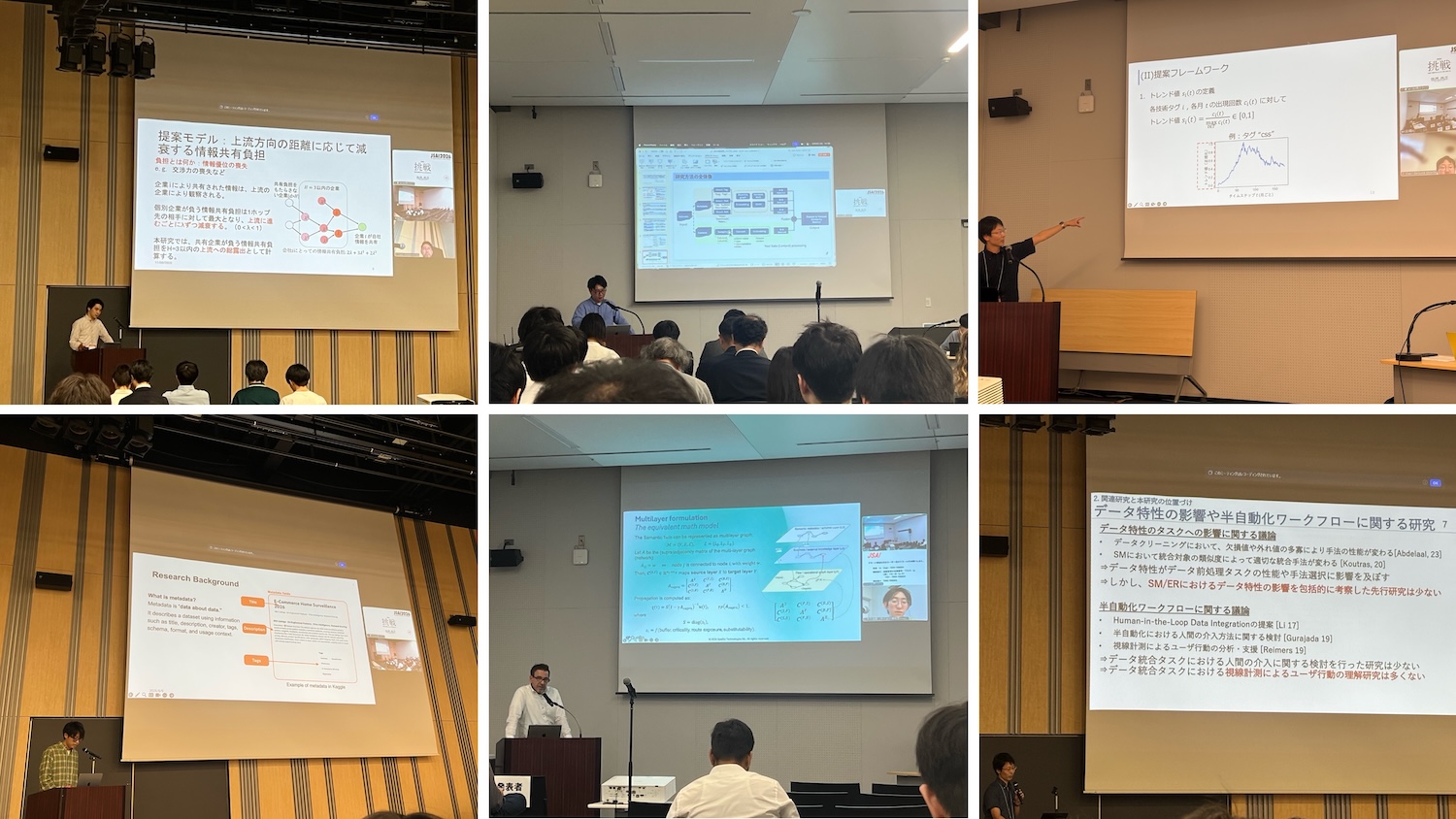
From June 8 to June 12, 2026, members of the Hayashi Laboratory presented six research papers at the 2026 Annual Conference of the Japanese Society for Artificial Intelligence (JSAI2026), held in Takasaki, Japan.
These presentations explored how data relationships and contextual information can be modeled and utilized to support AI-driven discovery, reasoning, and decision-making across a wide range of domains, including dataset discovery, heterogeneous data integration, enterprise data intelligence, supply chains, and software ecosystems.
Title: Dataset Similarity Learning via Multi-View Fusion of Metadata and Tabular Data Sampling
Authors: Haoyang Cheng, Teruaki Hayashi
This study proposes a dataset similarity learning framework for supporting dataset discovery in data-sharing and data-exchange environments. The proposed method integrates four complementary perspectives—tags, textual descriptions, user behavior, and sampled tabular content—to estimate similarities between datasets. Experiments using the Meta Kaggle repository demonstrate that the fusion of multiple views enables more robust dataset recommendation than approaches relying on a single source of information.
Title: Synchronous Trend Analysis of Software Technologies Using Graph Signal Processing
Authors: Masafumi Nishida, Teruaki Hayashi
This research applies graph signal processing to technology tag co-occurrence networks extracted from knowledge-sharing platforms to identify “synchronous trends,” where groups of related technologies evolve together over time. Rather than focusing on temporary popularity spikes of individual technologies, the method captures the growth and decline of technology clusters, providing a new perspective for understanding structural changes in software ecosystems.
Title: Eye-Tracking-based Evaluation of a Semi-Automated Workflow for Heterogeneous Data Integration
Authors: Yuka Haruki, Shigeru Ishikura, Kazuya Demachi, Teruaki Hayashi
This study evaluates a semi-automated workflow that combines algorithmic recommendations with human judgment for schema matching and entity resolution across heterogeneous datasets. Through eye-tracking experiments, we investigated how recommendation support influences users’ information-seeking and verification behavior, providing insights into the design of effective human-in-the-loop data integration systems.
Title: LLM-Driven Metadata Generation via Schema Matching and Semantic Profiling for Dataset Discovery
Authors: Mo Chen, Teruaki Hayashi
This research proposes an LLM-based framework for automatically generating metadata to improve dataset discovery in large-scale data lakes. Instead of relying on sampled data rows, the method focuses on schema-level profiling and generates two complementary outputs: a Search-Facing Description (SFD) optimized for retrieval tasks and a User-Facing Description (UFD) designed for human readers.
Title: Semantic Twin: A Heterogeneous Multilayer Network Model for Enterprise Data Intelligence
Authors: Loys Belleguie, Teruaki Hayashi, Takahiro Sanada
This work introduces the Semantic Twin, a heterogeneous multilayer network model that integrates metadata, operational data, and business knowledge within enterprises. By explicitly separating Schema, Flow, and Business layers and representing provenance, confidence, and knowledge status, the framework enables AI agents to reason while distinguishing facts, observed signals, and inferred knowledge.
Title: Analysis of the Trade-off between Corporate Information Visibility and Competitive Advantage in Supply Chain Networks
Authors: Mahiro Tajima, Teruaki Hayashi
This study examines the trade-off between improved supply chain visibility through data sharing and the potential loss of informational advantage for participating firms. By modeling supply chains as directed networks and simulating information-sharing scenarios, we show that firms occupying brokerage positions within the network face significantly greater risks of losing competitive advantages than firms characterized simply by a large number of transactions.